Text Summary – press to open
In this video, one can discover that our current food system is essentially a house of cards, but the “ancient future” of farming—agroforestry—is the secret key to unlocking a resilient, chemical-free world where trees and crops work in a beautiful, high-energy-yield dance.
One of the most powerful realizations in this documentary is that industrial agriculture is actually an energetic failure, requiring a staggering 10 calories of energy input for every single calorie of food produced. While we’re often told modern farming is the peak of efficiency, it’s actually a fragile system dependent on massive chemical corporations and global commodity markets. By moving away from flat, one-dimensional fields and embracing the vertical and temporal depth of trees, we find a way to grow food that actually builds soil, saves water, and fights off pests without a single drop of poison. This isn’t just a different way to farm; it’s a way to reclaim our local independence and health from a system that prioritizes tradable commodities over actual nutrition.
The Deep-Dive Story
A Tale of Two Droughts and the Thirst for Solutions
The story kicks off with a sobering reality check from Quinto Sapore, a regenerative farm in Italy run by brothers Alessandro and Nico. They are facing a brutal six-month drought where it simply doesn’t rain in the summer anymore.
- The Narrative Driver: The escalating frequency and severity of droughts is the ultimate challenge. Alessandro’s ultimatum? “Plant trees or close the farm.”
- Water Retention Secrets: Trees create a microclimate. Their dappled shade keeps the air moist and the soil hydrated, drastically reducing the need for external irrigation.
Efficiency vs. The Great Energy Lie
The video shatters the myth of industrial efficiency by comparing it to the natural logic of agroforestry.
- Caloric Input vs. Output: Industrial farming is an energy sink (10:1 ratio). Agroforestry, conversely, becomes more efficient as it matures, requiring fewer inputs while producing more food every year.
- The Commodity Trap: Why isn’t everyone doing this? Because big investors don’t want “food”; they want “commodities”—predictable, easy-to-harvest, identical crops like corn and soy that can be traded on global markets. Four companies own 60% of the world’s seed supply, and they aren’t incentivized to change.
The Three Pillars of Tree-Based Farming
The creator breaks down the practical application of these systems into three main categories:
- Alleycropping (The Multi-Dimensional Field):
- Planting rows of perennials (like walnuts) with annuals (like asparagus) in between.
- Adds a Vertical Dimension (growing up the trees with vines) and a Temporal Dimension (the system evolves from an annual-focused field to a perennial forest over 10-15 years).
- Silvopasture (The Animal Connection):
- Integrating animals with trees. For example, running chickens under apple trees.
- The Synergy: Chickens eat fallen fruit and pests (reducing pest pressure), fertilize the trees with high-nitrogen waste, and in return, get shade and protection from predators.
- Food Forests (Mimicking Nature):
- Embracing Succession. Nature doesn’t want to be a flat field; it’s always trying to become a forest.
- Working with nature instead of constantly resetting the clock with plows and chemicals.
The Magic of the Empress Tree
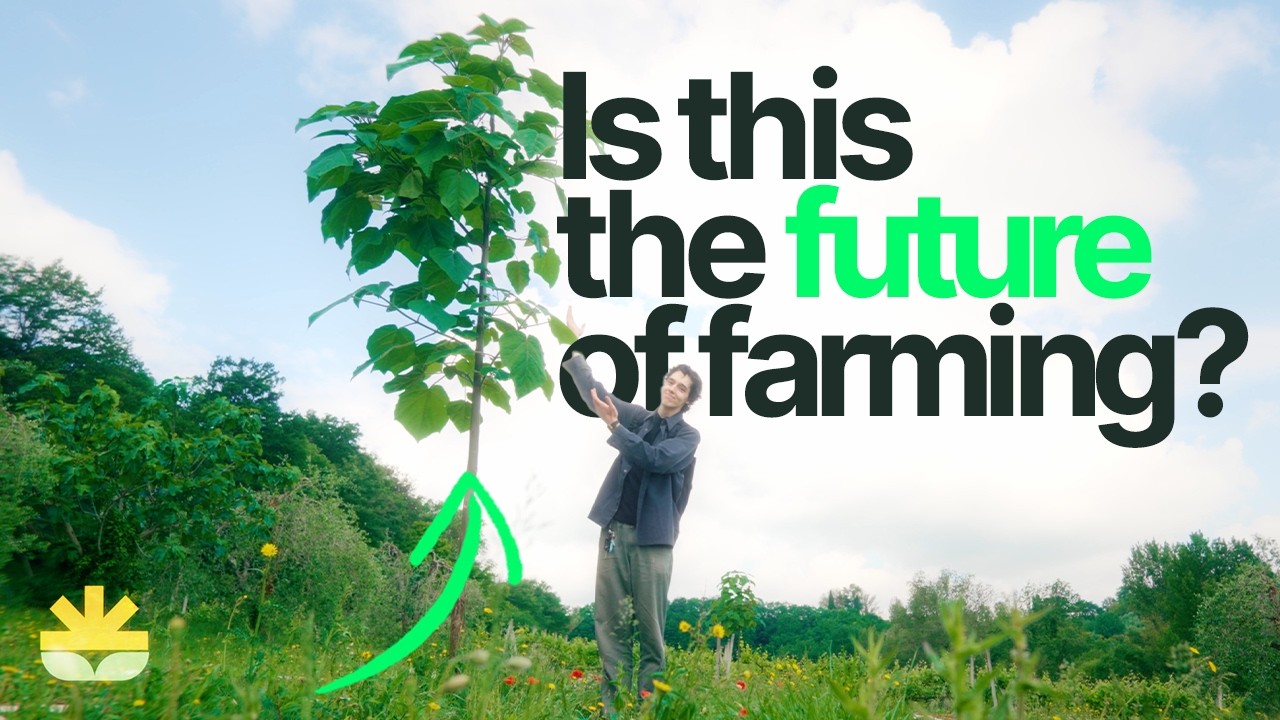
At Quinto Sapore, they use a specific secret weapon: the Paulownia (Empress Tree).
- Technical Stats: It is the fastest-growing tree on Earth.
- Deep Roots: Its roots go deep for water, meaning it doesn’t compete with surface-level vegetables for nutrients.
- Seasonal Strategy: It loses its leaves in autumn (allowing sun to reach the crops when warmth is needed) and grows massive leaves in summer (providing cooling shade).
- The “Boom”: Its purple spring flowers attract birds right when parasites emerge from the ground, creating a natural pest-control cycle.
- Coppicing: These trees can be cut at the base to create massive biomass/mulch, and they grow back stronger within a year.
Food for Thought
It’s fascinating to see the comparison between European settlers and Indigenous agroforestry. The fact that settlers saw a “wilderness” simply because there weren’t straight rows is a classic example of how our definitions of “order” and “management” can blind us to highly sophisticated, sustainable systems. My take? The biggest hurdle isn’t the science—it’s the aesthetics of the “neat” farm and the rigid structure of our global economy. Transitioning to agroforestry requires us to embrace a bit of “messiness” and complexity, which is exactly what a healthy ecosystem looks like.
Key Topics Covered
- Agroforestry vs. Industrial Agriculture
- Energy ROI (Input vs. Output Calories)
- Water Resilience & Microclimates
- Alleycropping, Silvopasture, and Food Forests
- The Paulownia Tree (Empress Tree) Benefits
- The Commodity Market vs. Local Food Security
- Succession and Natural Ecosystem Mimicry