What This Project Can Accomplish When Implemented, on short – press to open
Introduction
Humanity stands at a crossroads, grappling with an escalating migration crisis fueled by a complex interplay of factors: ongoing wars and conflicts, the accelerating impacts of climate change (such as droughts, floods, and heatwaves), deepening economic instability, and critical resource shortages—including topsoil degradation, crop failures, and water scarcity. These forces displace millions annually, driving them from their homes in search of safety, opportunity, and a chance to rebuild. Yet, the response from political systems is often inadequate—stifled by bloated bureaucracies, entrenched corruption, or outdated frameworks incapable of addressing the scale and nuance of this global challenge.
For much more information, a very in-depth and highly documented video-presentation (with numerous numbers, graphics and statistics) regarding migration, integration, multiculturality and the intrinsic current challenges – can be seen by pressing / opening this accordion
In this vacuum, grassroots innovation becomes not just an option, but a necessity. This project rises to meet that need, offering a comprehensive, technology-driven, and deeply humane model. We re-imagine migration not as a burden, but as a transformative opportunity—for migrants, host communities, and the global economy alike.
Also, it should be here mentioned as well the fact that, the project presented below and the systems within it are not meant to replace, but are complementary to a relatively balanced (generally speaking) migration policy such as the one recently implemented by Sweden, distilled in the following lines within this accordion below:
Sweden’s current Migration Policy: A Comprehensive Breakdown (press to open)
The Project – Executive Summary & Vision
This project proposes a groundbreaking solution to address the complexities of global migration by harnessing the power of technology, fostering collaboration, and prioritizing empowerment. Our mission is to redefine the role of migrants and refugees, enabling them to become dynamic contributors to their new societies. Central to this vision is a cutting-edge digital platform that assesses skills, professional aptitudes, and psychological profiles, offering standard and AI-driven job matching recommendations and a suite of additional tools, seamlessly integrated with a vibrant network of grassroots efforts. This cohesive ecosystem connects migrants and refugees to vital resources, opportunities, and support networks, paving the way for self-sufficiency and meaningful integration.
Core Principles
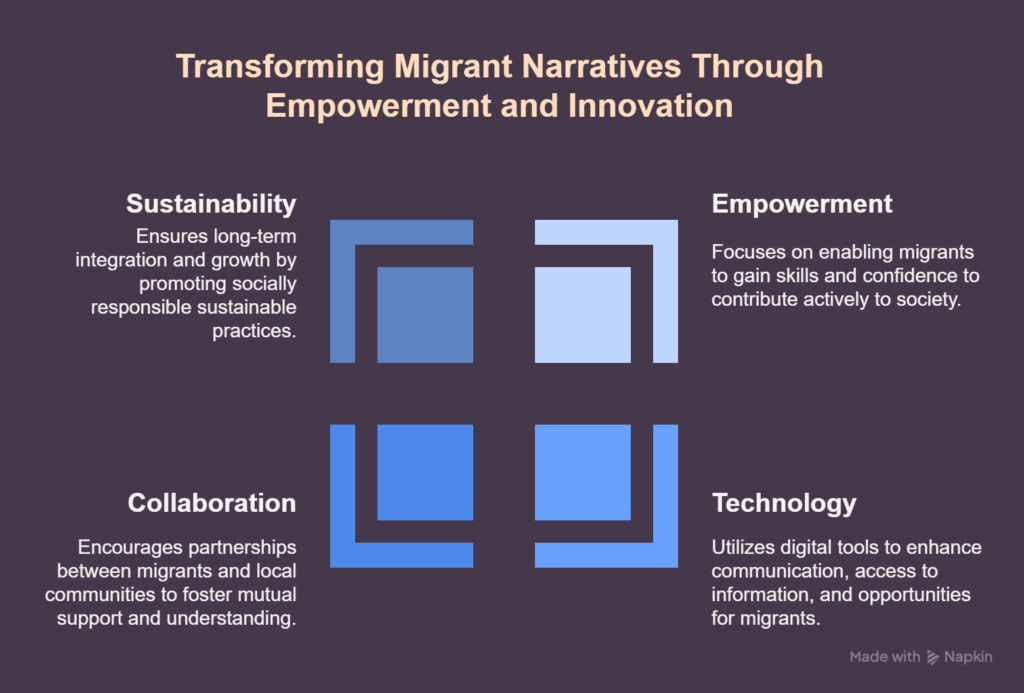
At its heart, this initiative is guided by four foundational pillars:
- Empowerment: Migrants should be potential entrepreneurs, innovators, and skilled contributors, not just passive recipients of aid. This pillar focuses on equipping them with the tools, opportunities, and support needed to thrive independently.
- Technology: By harnessing modern platforms, artificial intelligence (AI), blockchain, and more, we aim to create a system that is efficient, transparent, and beneficial to all involved.
- Collaboration: Recognizing that no single entity can solve this crisis alone, this project unites governments, NGOs, businesses, tech experts, and citizens in a coordinated effort to craft solutions that benefit everyone.
- Sustainability: Temporary fixes won’t suffice. We are designing self-sustaining systems that deliver long-term value—economically, socially, and environmentally—for migrants, host communities, and the global ecosystem.
I. The Centralized Portal/Hub
The cornerstone of this project is a centralized online platform—a digital “hub” acting as a lifeline for migrants and refugees. It seamlessly links them to resources, opportunities, and support, while empowering them to share their talents with employers and communities. The Portal / Hub will offer the following functionalities and benefits:
A. Acts as a Centralized Index for People and Opportunities:
Personal Profiles: The portal features a robust database where refugees and migrants can create profiles showcasing their skills, qualifications, work experience, passions, and personality traits. Optional, industry-standard assessments (like HEXACO, DISC, or Kolbe) and migration-specific tests (e.g., language proficiency, cultural adaptability) can provide deeper insights for personalized matching.
The portal also allows migrants to indicate their level of language proficiency in the language of the host country and in any other language. This information will be prominently displayed on their profile to facilitate accurate matching with employment and support services that align with their communication abilities.
Verification & Trust: To enhance trust, migrants can voluntarily opt-in to obtain “Trust Badges” for various aspects of their profile. This could involve using ethical, legal and accredited verification methods (potentially even inspired by systems like South Korea’s vetting for North Korean migrants) to validate specific, objective claims like certifications or stated technical skills or language proficiency. This process would be fully transparent and require explicit consent for all aspects of it.
Secure Credentials: Verified information like educational records, work history, and certifications can be stored as Soulbound Tokens (SBTs)—which are relatively standardized non-transferable, blockchain-based digital credentials. SBTs allow migrants to securely carry their validated achievements across borders, simplifying resettlement.
Powerful Filter-based Job-Matching along with smart A.I.-Powered matching recommendations: A powerful filtering system will allow for the employers and employees (/refugees & migrants) to easily and very precisely match on a wide range of preferred criteria (including skills, language proficiency, personality aspects, and even optional cultural adaptability assessments) – while a very smart A.I. algorithm will also be available to recommend highly compatible jobs and also relevant training programs if necessary. Migrants can also optionally respond to questions and tests within the platform in order to evaluate their openness to workplace norms, such as punctuality, teamwork, and communication styles, improving job-matching accuracy.
Migrant Innovation Hub: A unique feature allows migrants to pitch entrepreneurial ideas (e.g., a small food business, a translation service) for crowdfunding or investor matching.
Feedback Loop: Employers, donors, and volunteers can provide feedback on interactions (with migrant consent), fostering accountability, while migrants can respond. AI continuously analyzes feedback to identify trends and suggest platform improvements.
Privacy Controls: Users maintain control over their data, choosing anonymity levels or deciding which information (e.g., skills vs. personal history) is shared publicly.
the optional Cultural Adaptability section (press to open for more details) – This section / functionality within the portal aims to provide a more nuanced understanding of a migrant’s potential to integrate successfully into a new cultural environment. It is designed to be optional, allowing migrants to choose the level of information they wish to share.
Willingness to Adapt:
- A self-assessment section where migrants can express their openness to adopting new customs, etiquette, and social norms.
- This could include questions about their past experiences with cultural transitions, their comfort level with diversity, and their attitude towards learning about and respecting different value systems.
Cultural Skills and Knowledge:
- A space for migrants to highlight any specific cultural skills or knowledge they possess that could be an asset in cross-cultural settings.
- Examples include:
- Proficiency in multiple languages
- Experience working or living in multicultural environments
- Knowledge of specific cultural practices or traditions
- Skills in cross-cultural communication or conflict resolution
Cultural Sensitivity:
- An optional section where migrants can share examples of how they have demonstrated cultural sensitivity and respect in the past.
- This could include instances where they have successfully navigated cultural differences, resolved misunderstandings, or promoted inclusion.
Integration Goals:
- A brief statement where migrants can outline their personal goals for cultural integration, such as:
- Building relationships with members of the host community
- Participating in local cultural events and activities
- Contributing to a harmonious and inclusive society
Optional Assessments:
- Migrants may choose to complete optional assessments designed to measure cultural intelligence (CQ) or intercultural competence.
- These assessments can provide a more objective measure of their cultural adaptability and identify areas where they may benefit from additional support or training.
B. Practical Support
The portal also serves as a ‘one-stop shop’ for:
- Jobs: A highly filterable database and AI assistance help migrants find suitable job openings and apprenticeships based on their profiles, skills, passions, interests, and language proficiency. Employers can find candidates with the right skills, passions, or interests, while also filtering by language skills and cultural adaptability. The platform will also offer cultural sensitivity training for employers, including free courses or webinars on managing diverse teams, understanding cultural differences (e.g., religious practices like Ramadan), and fostering inclusive workplaces.
- Support Network: Volunteers offer translation, paperwork assistance, and cultural guidance.
- A peer-to-peer mentorship program: which will pair successfully integrated migrants with newcomers, offering guidance on navigating cultural expectations and fostering a sense of belonging in the host country while respecting migrants’ own identities. Mentors will receive training on promoting mutual understanding, integration and cultural sensitivity and awareness, to better equip them to guide newcomers through the cultural integration process. The program will also facilitate connections between migrants and members of the host community to foster social interaction and mutual understanding.
- Funding: Blockchain technology ensures transparency for donations, microloans, and profit-sharing from migrant-run cooperatives. A crowdfunding module allows direct support for migrant-led projects, like funding startup equipment for a refugee launching a tailoring business.
- Housing: Detailed listings include costs, rules, proximity to jobs, and virtual reality (VR) tours to help migrants visualize potential homes before committing.
C. Free Educational Resources
A rich library of free online courses equips migrants for their new lives:
- Legal Navigation: Guides on local laws, visas, and residency processes.
- Skills Development: Training to enhance existing skills or learn new ones.
- Cultural Integration: Lessons on local customs, etiquette, communication norms, and relationship-building. Additionally, the platform will also offer modules focused on host-country values, laws and civic duties and responsibilities. These lessons will cover the host country’s history, governance and participation principles, and societal expectations, such as respect for local laws, gender equality, and secularism. Completion of these modules will be incentivized through the gamification system, with users earning badges or points for participation.
- Self-Reliance: Tutorials on urban gardening, financial literacy, basic repairs, or sustainable practices like aquaponics or permaculture.
- Health and Wellness: Resources for physical and mental well-being, including stress management techniques.
- Climate Resilience: Modules teaching adaptation strategies relevant to the host environment, such as water conservation techniques in arid regions or flood-proofing practices.
- Gamification: Completing courses earns badges or points, potentially redeemable for microloans, tools, or priority access to certain programs, making learning engaging and rewarding.
D. Volunteer Training
Volunteers are vital in this context. Volunteer training will include modules on recognizing and addressing potential challenges related to discrimination, prejudice, and cultural misunderstandings. Volunteers will be trained to act as mediators and advocates, promoting respectful communication and conflict resolution. We will offer free, tiered training (Basic, Intermediate, Advanced) to support them:
- Basic: Platform navigation, simple translation tasks.
- Intermediate: Guiding migrants through assessments, assisting with job applications.
- Advanced: Providing specialized support like navigating complex legal aid referrals or offering advanced digital literacy training. This ensures volunteers are matched effectively to roles, maximizing impact.
E. News and Resources
The portal keeps users informed with:
- Updates on immigration policy changes and their implications for migrants, helping users navigate evolving systems and stay informed about opportunities, new skill-building programs and challenges.
- An open-source library with downloadable blueprints and guides for community projects like cooperatives or sustainable housing models, customizable for local adaptation.
- Updates on local cultural events, community initiatives, and relevant job openings.
To also counter negative stereotypes, the platform will launch public awareness campaigns showcasing success stories of migrant integration and contributions. These campaigns will be promoted through the ‘News and Resources’ section and in collaboration with media outlets or influencers to foster positive narratives about migrants.
II. Essential Supporting Systems
Beyond the digital portal, holistic support is crucial.
A. Psychological Support and Trauma Healing
Migration often involves trauma. Our approach includes:
- Access to free or subsidized therapy sessions with trained psychologists (online or in-person).
- Optional VR tools for trauma processing, using methods similar to those for Post-Traumatic Stress Disorder (PTSD) treatment in veterans.
- AI-driven mental health chatbots offering 24/7 multilingual support with coping strategies and mindfulness exercises, escalating urgent cases to human experts.
- Volunteer training in basic psychological first aid and empathetic listening.
- Key Performance Indicators (KPIs): Success measured by session numbers, user satisfaction ratings, and pre/post assessments of reported anxiety/well-being levels.
B. Positive and Uplifting Community Events
These events will foster community bonds and aid psychological healing, held near migrant hubs or integrated within host communities. They will be designed to promote intercultural dialogue, celebrate diversity, and create opportunities for interaction and relationship-building between migrants and host community members. The events will also provide platforms for addressing sensitive topics such as discrimination, prejudice, and cultural differences in a safe and constructive environment.:
- Arts and Storytelling: Art shows, theatre workshops, and performances inviting migrants to express their stories, fostering catharsis and agency.
- Music and Movement: Concerts and dance workshops to lift spirits and connect people through shared cultural expression.
- Recreation: Sports tournaments or community gardening projects that blend friendly competition with collaboration, reducing isolation. These gatherings serve as informal therapeutic spaces, weaving healing into celebration.
C. Creating Self-Sustaining Communities
We aim to help migrants build thriving ecosystems:
- Special Development/Economic Zones (SDZs/SEZs): Exploring designated areas with integrated planning for affordable housing, schools, infrastructure, and job opportunities, potentially incorporating models where residents hold equity stakes.
- Charter Cities Concepts: Investigating innovative governance models for new settlements, potentially using digital tools for resident participation, focusing on providing basic needs efficiently. An “Open-Source Resource Library” on the portal shares adaptable blueprints and best practices for these models.
- Cooperatives & Incubators: Supporting migrant collaboration to produce goods/services (e.g., catering cooperative, bicycle repair shop, tech support hub) with training, tools, and potentially facilitated access to tax incentives. A dedicated “Buy from Migrants” marketplace on the portal showcases their offerings.
- Example Timeline: Phase 1 (Year 1): Feasibility studies, planning, and partnership building for initial SDZ/Cooperative pilots. Phase 2 (Years 2–3): Construction/launch of pilots, initial community integration. Phase 3 (Years 4+): Scaling successful models, refining based on data, and encouraging global replication.
III. Governance & Technology Foundation
A robust and transparent structure is essential for success.
A. Non-Profit Structure & Governance
This initiative operates as a traditional non-profit, reinvesting all funds into its mission with unwavering transparency. Key features include:
- Decentralized Advisory Board: Uniting migration experts, economists, technologists, legal professionals, and migrant representatives for diverse strategic guidance. The decentralized advisory board will unite migration and social integration experts, economists, technologists, legal professionals, migrant representatives, and experts in host-country policy and integration, ensuring diverse strategic guidance and the best practices in promoting social cohesion while addressing the challenges of multiculturalism.
To ensure alignment with host-country needs, the project will establish regular stakeholder forums or advisory boards that include local leaders, policymakers, and host-community representatives. These forums will meet quarterly or bi-annually to discuss integration strategies, resource allocation, and community feedback, balancing migrant voices with broader societal priorities. - Policy Advocacy and Partnerships: The project will include a policy advocacy component, collaborating with NGOs , CSOs, research institutions, and government agencies to promote immigration policies that prioritize skilled migrants or those with higher cultural adaptability, inspired by successful models like Singapore’s selective approach. The platform will publish research and reports on the benefits of such policies for long-term integration success.
- Radical Transparency: Annual public audits, published online, detailing funding sources, expenditures, and program outcomes (e.g., number of jobs filled, courses completed).
- Collaborative Decision-Making: Regular forums and feedback mechanisms ensure key stakeholders, especially migrants themselves, co-shape the project’s evolution.
- Potential DAO Integration: Exploring a Decentralized Autonomous Organization (DAO) model for specific functions, allowing verified community members (migrants, volunteers, partners) to propose and vote on certain platform upgrades or resource allocations using blockchain, ensuring grassroots input.
B. Enabling Technologies
Technology enhances efficiency, trust, and reach:
- Blockchain: Secures financial transactions (donations, microloans, cooperative revenue sharing) and hosts the Soulbound Tokens (SBTs) for verifiable, portable digital credentials. This digital reputation simplifies access to services across borders.
- Artificial Intelligence (AI): Powers personalized matching recommendations (jobs, training, support), helps predict integration challenges or resource needs, analyzes feedback for platform improvement, and drives multilingual support chatbots. AI algorithms will be used to analyze data on integration outcomes, identifying factors that contribute to successful integration and potential barriers. This data will be used to refine the platform’s features and services, and to inform policy recommendations.
- Virtual Reality (VR): Used optionally for immersive trauma therapy, virtual job previews, or remote housing tours.
- Security: Regular, independent security audits safeguard all user data and platform integrity.
IV. Promotion, Collaboration & Rollout
- Promotion: Initial promotion will focus on targeted outreach via NGOs and community leaders in pilot areas, using flyers, social media, and informational sessions. As funding grows, broader campaigns and word-of-mouth from success stories will drive adoption.
- Pilot Phase: Launching initially in a specific region (e.g., a city with a significant migrant population or near a large camp) to test and refine the portal based on real-world user feedback before wider rollout.
- Partnerships: Collaborating strategically with governments (for policy alignment, SEZ support, and the development of integration policies), NGOs (for outreach and service delivery), tech companies (e.g., for cloud infrastructure, AI tools), universities (for research, volunteers, and the evaluation of integration programs), and businesses (for job opportunities, investment, and the promotion of inclusive workplaces) is crucial for impact and sustainability.
V. Call to Action & Milestones
Join us in transforming the migration narrative from one of crisis to one of opportunity. Your involvement—whether through volunteering time and skills, providing financial support, or forming strategic partnerships—is vital.
Funding Milestones & Recognition:
- €100,000: Build the core portal features, establish initial partnerships, and secure necessary legal/operational groundwork for a pilot launch.
- €150,000: Launch the pilot program, initiate promotional activities, and begin advocacy for supportive policies like SDZs.
- €200,000+: Scale operations, enhance platform features based on pilot data, expand outreach, and boost overall adoption speed and efficiency.
- €300,000+: Develop and implement programs focused on promoting social cohesion and intercultural dialogue between migrants and host communities. Establish partnerships with organizations specializing in diversity training and conflict resolution. Conduct research to evaluate the effectiveness of integration initiatives and inform policy recommendations.
Donors contributing €10,000+ receive recognition on our Founders’ Page (unless anonymity is preferred):
- Bronze: €10,000–€24,999
- Silver: €25,000–€49,999
- Gold: €50,000+
- Platinum: €100,000+
Closing Vision
By 2030, we aim to empower 1 million migrants to build self-sufficient lives, facilitate the creation of 500,000 jobs through the platform and associated initiatives, and demonstrably contribute to reducing migration-related hardships through improved integration and opportunity access.
Together, we can transform migration from a challenge into a catalyst for growth, innovation, and global unity.
Please act now. Share this page, donate, or volunteer today to help rewrite the narrative of migration worldwide.